How to know if a business idea is profitable
Profitable ≠ “good idea”. The 5-step method to decide with data, not a gut feeling.
Updated July 22, 2026 · 10 min read
Most founders “validate” their idea the worst way possible: they tell friends and family and take the “oh that's cool!” as a green light. But kindness isn't data. A profitable idea isn't felt — it's measured, with real signals, for free, in 30 minutes. Here's the exact method to decide go / no-go with no budget and no wishful thinking.

Profitable ≠ “good idea”: the distinction that changes everything
A “good idea” is appealing. A profitable idea meets three conditions that have nothing to do with your enthusiasm:
- Demand — enough people already look for a solution to this problem.
- Reachability — you can reach those people without a huge budget.
- Monetisation — they're used to (or willing to) pay for it.
Remove a single pillar and profitability collapses: strong demand + zero willingness to pay = traffic that funds nothing. Strong willingness to pay + no reachable audience = a theoretical market. Profitability lives at the intersection of the three, not in originality.
Why a “too original” idea is often a bad sign
If nobody does what you want to do, there are two explanations: either you're a visionary genius, or others tried and the market doesn't pay. Statistically, the second is far more common. A total absence of competition is rarely a windfall — it's usually a warning.
Step 1 — Check that real demand exists
First things first: are people actively looking for a solution? Demand leaves measurable traces, for free.
Read search volume (and what a low number really means)
Type the core of your idea into Google and watch the autocomplete suggestions: these are real queries, ranked by frequency. A rich field of varied suggestions = living demand. Low volume isn't always a deal-breaker: for an expensive, recurring product, a few hundred highly qualified searches beat 50,000 lukewarm ones. Never look at volume alone — look at it next to intent (step 4).
Spot seasonal or declining demand with Google Trends
Run the main keyword through Google Trends over 12 to 24 months. A rising curve = a market coming to you. A free-falling curve = a train leaving the station: even with demand today, you arrive late. Watch out for sawtooth patterns — a spike every December signals seasonality that can wreck your cash flow if you don't plan for it. To go further, see our guide using Google Trends to validate an idea.
The YouTube signal: are people trying to learn and solve this?
Search your topic on YouTube. Recent videos with tens of thousands of views = an audience that wants to understand and solve this problem. A desert = either a dead niche or a topic nobody seeks to learn (a bad sign for an educational or software product).
Step 2 — Measure the pain (is the problem worth paying for?)
Nobody pays for a lukewarm problem. Profitability is proportional to the intensity of the pain you relieve.
The 4 levels of problem intensity
- Annoying — “that would be nice”. Nobody pulls out the card. Dead zone.
- Costly — it regularly wastes time or money.
- Blocking — it prevents progress on something important.
- Urgent — it's burning right now. Here people pay fast and pay well.
Aim for “costly” at minimum. Below that, even great execution won't make the idea profitable.
Where to find proof of the pain
Read where your target complains: niche forums, 1–3 star reviews of competing tools (a gold mine), Facebook/Reddit groups, YouTube comments. Recurring phrases like “I waste so much time on…” or “no tool does … properly” are wallet signals, not mere opinions.
Step 3 — Assess competition without getting discouraged
Take this in once and for all: competition is proof, not an obstacle. Players making a living from that market confirm there's money in it. The question isn't “how do I be the only one?” but “healthy or locked?”.
✅ Healthy competition
- Several profitable players, but none dominates everything
- Customer reviews point to specific gaps
- Segments (trade, region, niche) are poorly served
- New entrants keep appearing
⛔ Locked market
- 1–2 giants capture everything, huge ad budgets
- Acquisition cost out of reach for an indie
- Product became a commodity, prices crushed
- No credible angle of differentiation
If you land on “saturated but with poorly served segments”, read our guide saturated niche: how to tell and what to do.
Step 4 — Test willingness to pay
Everything above measures interest. Profitability depends on one thing: do people pay? And that can be tested before you build.
The landing page test (pre-sell method)
Build a page that describes the offer as if it existed, with a buy or pre-signup button. Send traffic to it (your network, a community, a small ad budget) and measure how many reach the intent to pay. This is the “fake door” technique, detailed in our guide test an idea with a landing page.
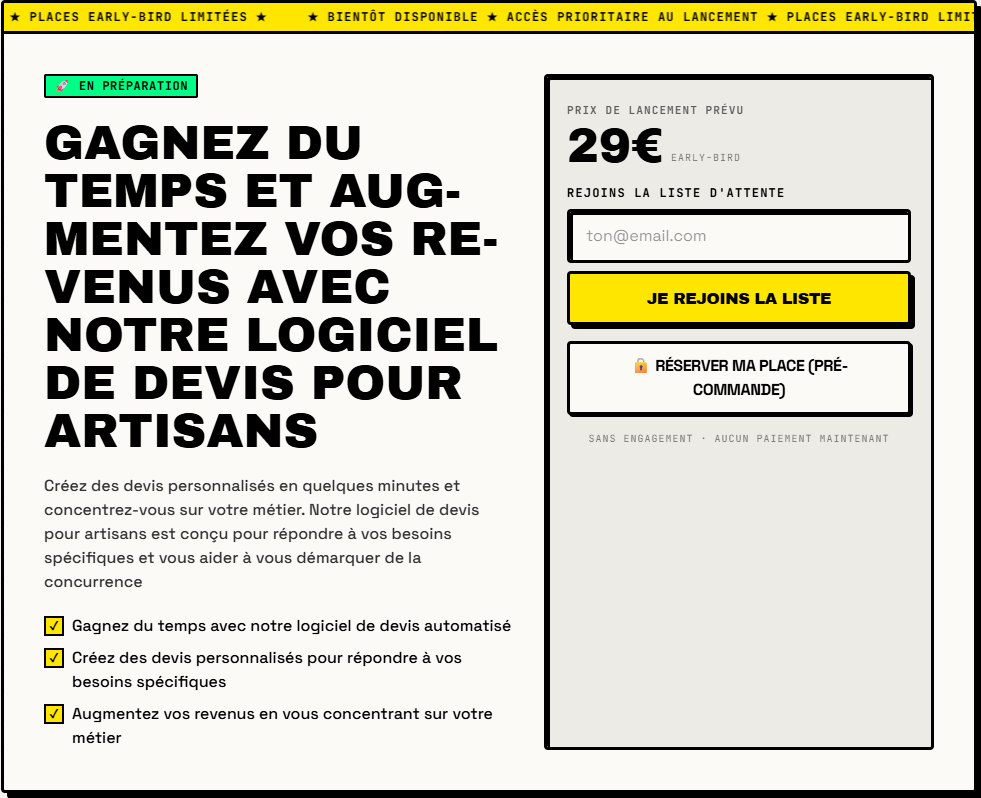
What conversion rate actually validates an idea
No universal magic number, but ballparks: on cold traffic, a sign-up conversion below 1–2% is lukewarm; above 5%, you have a strong signal. And a single paid pre-sale is worth more than 500 free sign-ups: email measures interest, payment measures value.
Step 5 — Estimate profitability potential (order of magnitude)
You don't need a 40-page business plan. A back-of-the-napkin estimate is enough to know whether the game is worth the candle.
The simple formula
Potential revenue ≈ Addressable audience × Conversion rate × Price. Be deliberately pessimistic on every term: if the idea still looks interesting under low assumptions, it's solid. If it's only profitable in a perfect scenario, be wary.
Concrete example — an invoicing micro-SaaS for freelancers.
Targeted monthly searches: ~3,000. Realistically reachable share in year one (SEO + word of mouth): 3% → 90 qualified visitors/month. Conversion to paying subscriber: 4% → ~3–4 new customers/month. Price: €8/month. After 12 months, if retention holds: ~35 active customers ≈ €280/month recurring. Modest, but real — and above all validated before writing a single line of code. Up to you to judge whether the trajectory justifies the effort.
The “profitable idea” 10-point checklist
If you tick at least 7 out of 10, you have a real candidate:
- People actively search the topic (rich autocomplete).
- The 12-month trend is stable or rising.
- The pain is at least “costly”, not just “annoying”.
- You find concrete complaints in reviews/forums.
- Competitors exist… but with poorly served segments.
- No giant fully locks the market.
- You can reach your target without a massive ad budget.
- The target already pays for this type of tool.
- A pre-sale or landing converts above the noise.
- The estimated potential (even pessimistic) justifies your time.
Automate this analysis in 30 seconds
Doing these five steps by hand takes 30 to 60 minutes per idea. Sondari automates the measurable part: it cross-references Google Autocomplete, Google Trends and YouTube, computes a Sondari Score across demand, trend, competition and purchase intent, and hands you a clear verdict — enough to screen ten ideas in an afternoon instead of one in a week. It doesn't replace the pre-sale (nothing does), but it saves you from wasting time on ideas that fail at step 1.
Logical next step once the idea is validated: launch an MVP quickly without over-engineering.
Frequently asked questions
Can you tell if a business idea is profitable without spending money?
Yes. Demand, trend and purchase intent can all be measured for free with Google Autocomplete, Google Trends and YouTube. A budget only becomes useful when you test willingness to pay at scale (ads to a landing page) — and even then, pre-selling to your own network costs nothing.
How many monthly searches are needed to validate demand?
There is no universal threshold: it depends on price and recurrence. For a micro-SaaS at a few euros per month, a few hundred to a few thousand targeted searches can be enough if purchase intent is strong. An expensive, one-off product can be profitable on lower but highly qualified volume. Always look at volume × intent, never volume alone.
Should you drop an idea if it already exists?
No — quite the opposite. Competitors making a living from that market prove there is money in it. The real danger isn't competition, it's an empty market. Your question isn't “how do I be the only one?” but “which segment or angle are the incumbents serving badly?”.
How long does it take to validate a business idea?
The manual method described here takes 30 to 60 minutes per idea. The goal isn't absolute certainty but an informed go / no-go. You can screen ten ideas in an afternoon instead of betting months on a single hunch.
Can AI validate a business idea for me?
AI can speed up gathering and summarising the signals (that's what Sondari does by cross-referencing demand, trend and competition), but it doesn't replace proof of payment. No tool replaces the moment a real customer pulls out their card: data lowers the risk, it doesn't remove it.
From theory to a verdict
Sondari does all of this automatically: real demand, trend, competition and purchase intent cross-referenced in 30 seconds.
⚡ Crash-test my ideaRead next on idea validation
How to gauge product demand before you launch
Demand is measured before you build, not after. 4 free sources and a clear decision framework.
Search volume: how to read it (without getting it wrong)
A big volume can hide a dead market, a small one a gold mine. How to really read the number.
B2B vs B2C market research: concrete method and differences
Low volume ≠ bad market in B2B. The differences that change your whole validation method.